Naugatuck Valley County Dog Registration Information
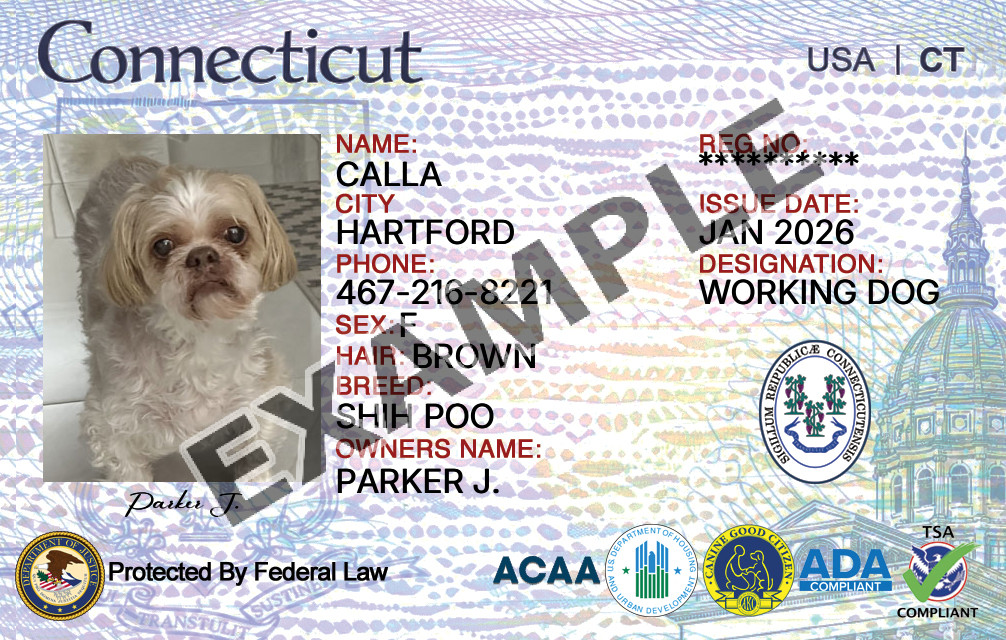
Service Dogs and Emotional Support Animals in Naugatuck Valley, Connecticut
If you’re searching for where do I register my dog in Naugatuck Valley County, Connecticut for my service dog or emotional support dog, the key thing to know is that Connecticut dog “registration” is typically handled as an annual municipal dog license (usually issued by your local Town Clerk/City Clerk). There is no single universal federal government registry for service dogs or emotional support animals (ESAs). In most cases, you will still license your dog with the town/city where you live, even if the dog is a service dog or an emotional support dog.
Where to Register or License Your Dog in Naugatuck Valley County, Connecticut
The offices below are official municipal contacts that handle dog licensing and/or animal services for residents in and around the Naugatuck Valley region. If you live in a different municipality within the Naugatuck Valley, your local Town Clerk/City Clerk is typically the correct starting point for a dog license in Naugatuck Valley County, Connecticut.
Borough of Naugatuck — Town Clerk (Dog Licensing)
- Phone: (203) 720-7000
- Hours: Monday–Thursday: 8:30 AM–4:00 PM; Friday: 8:30 AM–12:00 PM (Friday afternoons by appointment only after 12:00 PM)
City of Waterbury — Town Clerk (Dog Licensing)
- Phone: (203) 597-3444
- Hours: Monday–Friday: 8:30 AM–4:30 PM
City of Derby — Town Clerk (Dog Licensing)
- Phone: (203) 736-1450
- Hours: Monday–Wednesday: 8:30 AM–5:00 PM; Thursday: 8:30 AM–6:00 PM; Friday: 8:30 AM–12:30 PM
Town of Seymour — Town Clerk (Dog Licensing)
- Phone: (203) 888-0519
- Email: lmcmurray@seymourct.org
- Hours: Monday–Thursday: 8:00 AM–4:30 PM; Friday: 8:00 AM–12:00 PM
Town of Oxford — Town Clerk (Dog Licensing)
- Phone: (203) 828-6602
- Hours: Monday–Thursday: 9:00 AM–5:00 PM; Friday: 8:00 AM–12:00 PM
City of Ansonia — Town Clerk (General Municipal Clerk Contact)
- Phone: (203) 736-5980
City of Waterbury — Animal Control (Stray, Enforcement, Shelter Services)
- Phone: (203) 574-6909
- Hours: Monday–Friday: 8:00 AM–4:00 PM
Overview of Dog Licensing in Naugatuck Valley County, Connecticut
How licensing usually works
In Connecticut, dog licensing is commonly administered at the municipal level (your town or city). In other words, “Naugatuck Valley County” residents typically license their dogs through the Town Clerk/City Clerk office for the municipality where they live (for example, a dog license in Naugatuck Valley County, Connecticut may be issued by the Naugatuck Town Clerk if you reside in Naugatuck).
Licensing is separate from service dog or ESA status
A dog license is a local registration/identification step tied to public health and animal control. A service dog’s legal status is based on disability-related training and function. An emotional support animal’s status is based on a disability-related need supported by clinical documentation (in contexts where ESA rules apply). These are different concepts, and most residents should expect to complete regular municipal dog licensing requirements regardless of whether the dog is a service dog or emotional support dog.
What You Need Before Registering a Dog
Common documents and information requested
While each municipality can set its own procedures, dog licensing requirements in Naugatuck Valley County, Connecticut commonly include:
- Rabies vaccination proof (often required to be current; typically a certificate signed by a veterinarian)
- Spay/neuter proof (if applicable, to qualify for the altered-dog fee category when offered)
- Owner and dog details (name, address, phone; dog name, color, age, and breed)
- Payment for the license and any late fee if renewing after the local due date
Why rabies proof matters
Municipal licensing often ties directly to rabies compliance and lost-dog identification. Even when your dog is a service dog or emotional support dog, municipalities may still require proof of rabies vaccination to issue the dog license tag.
Steps to Register or License a Dog in Naugatuck Valley County, Connecticut
Step 1: Identify your municipality’s licensing office
Start with your Town Clerk/City Clerk in the municipality where you live (for example: Naugatuck, Waterbury, Derby, Seymour, Oxford, Ansonia). This is the most reliable answer to “where to register a dog in Naugatuck Valley County, Connecticut,” because there generally isn’t a single countywide licensing office for all towns.
Step 2: Gather required proof
- Rabies vaccination certificate (current)
- Spay/neuter documentation (if applicable)
- Identification and any residency documentation if requested by your municipality
Step 3: Apply in person or by mail (and keep copies)
Many Town Clerk offices accept applications in person during business hours, and some towns also support mail-in registration. If mailing, it’s common to include copies of documents and a return envelope for the tag. Keep a copy of what you submit for your records.
Step 4: Attach the license tag to your dog’s collar/harness
Once issued, you typically receive a paper license record and a metal tag. The tag should be attached to your dog’s collar or harness when the dog is out in public.
Service Dog Laws in Naugatuck Valley County, Connecticut
No universal federal “service dog registration”
Service dogs are not made “official” by a single government registration website. In most real-world situations, what matters is whether the dog is trained to perform tasks for a person with a disability and whether the handler is covered under the relevant laws for public access and accommodations.
Licensing vs. service dog status
Even if your dog is a service dog, you may still need a municipal dog license (the standard dog license in Naugatuck Valley County, Connecticut) through your Town Clerk/City Clerk. If a municipality offers a special fee category for certain working dogs, confirm the exact documentation needed directly with your local clerk office.
Emotional Support Animal Rules in Naugatuck Valley County, Connecticut
What an emotional support animal is (and isn’t)
An emotional support animal (ESA) is generally an animal that provides comfort to a person with a disability-related need and may be supported by documentation from a qualified healthcare professional in contexts where ESA accommodations apply. ESAs are not the same as service dogs because they are not defined by task-training for disability-related work in public settings.
Licensing still typically applies
If you keep a dog as an emotional support dog, you generally still complete the animal control dog license process used by your municipality (typically through the Town Clerk/City Clerk). The ESA designation does not usually replace local dog licensing requirements, including proof of rabies vaccination.
Dog License vs. Service Dog vs. Emotional Support Animal (Comparison)
| Category | What it is | Who issues/recognizes it | Typical documentation | What it affects locally |
|---|---|---|---|---|
| Dog License | Municipal license/tag for a dog kept in a town/city; often renewed annually. | Your local Town Clerk/City Clerk (municipality where you live). | Rabies vaccination proof; sometimes spay/neuter proof; owner/dog details; payment. | Compliance with local ordinances, identification if lost, and potential late fees/penalties if not licensed. |
| Service Dog | A dog trained to do specific work or tasks for a person with a disability. | Recognized under applicable disability-access laws based on training and function (not a single federal registry). | Typically not a “registration” document; some handlers carry training records or vet records for practical purposes. | Public access and accommodation rights where the law applies; does not automatically replace municipal licensing. |
| Emotional Support Animal (ESA) | An animal that provides comfort/support related to a disability in contexts where ESA accommodations apply. | Typically supported by healthcare documentation in relevant settings; not a universal registry. | ESA letter/documentation (when applicable) plus normal vet records; municipal dog license still often required. | May relate to certain housing accommodation requests; generally does not grant the same public access as a service dog. |
Frequently Asked Questions
Do I register my service dog or emotional support dog through the county?
Usually, no. Dog licensing in the Naugatuck Valley area is generally handled by each municipality (Town Clerk/City Clerk), not a single countywide office. For service dogs and ESAs, there is also no universal federal registry that you must use. Your first step is typically to get a municipal dog license where you live.
Is rabies vaccination proof required for a dog license?
In many municipalities, yes. Municipal dog licensing commonly requires a current rabies certificate. If you are missing paperwork, contact your vet for records before you apply.
What if I live near a town line in the Naugatuck Valley?
License your dog in the municipality where you are a resident (where the dog is primarily kept). If you recently moved, contact your new Town Clerk/City Clerk to ask what they need to issue a license in the new town.
Should I contact animal control or the Town Clerk?
For the license itself, start with the Town Clerk/City Clerk. For stray dogs, bites, nuisance complaints, welfare checks, or enforcement, contact your local Animal Control agency (if listed/available for your municipality).
Register A Dog In Other Connecticut Counties
Select your county below to get started with your dog’s ID card. Requirements and license designs may vary by county, so choose your location to see the correct options and complete your pup’s registration.
- Capitol Dog License Cards
- Connecticut's eight historical counties Dog License Cards
- Fairfield Dog License Cards
- Greater Bridgeport Dog License Cards
- Hartford Dog License Cards
- Litchfield Dog License Cards
- Lower Connecticut River Valley Dog License Cards
- Middlesex Dog License Cards
- New Haven Dog License Cards
- New London Dog License Cards
- Northeastern Connecticut Dog License Cards
- Northwest Hills Dog License Cards
- South Central Connecticut Dog License Cards
- Southeastern Connecticut Dog License Cards
- Tolland Dog License Cards
- Western Connecticut Dog License Cards
- Windham Dog License Cards
